What If School Felt Like a Launchpad?
What happens when a high school treats curiosity as more than a personality trait? What if students could spend their school years asking big questions and then actually test the answers? For many students interested in science and technology, Tesla STEM High School in Redmond, Washington offers that kind of environment. The school has developed a reputation for giving students a challenging academic experience while encouraging them to think beyond the usual textbook lessons.
A School Designed Around STEM
Tesla STEM High School focuses on science, technology, engineering and mathematics. However, the experience goes beyond simply adding more science classes to a regular schedule. Students work in an environment that expects them to analyze information, solve problems and connect ideas across different subjects. For students who enjoy understanding how things work, that approach can feel exciting. For students who prefer a slower academic pace, it can also feel demanding. If you are exploring more education stories and school-related topics, you can also visit ViziToNews for additional reading.
Where Is Tesla STEM High School?
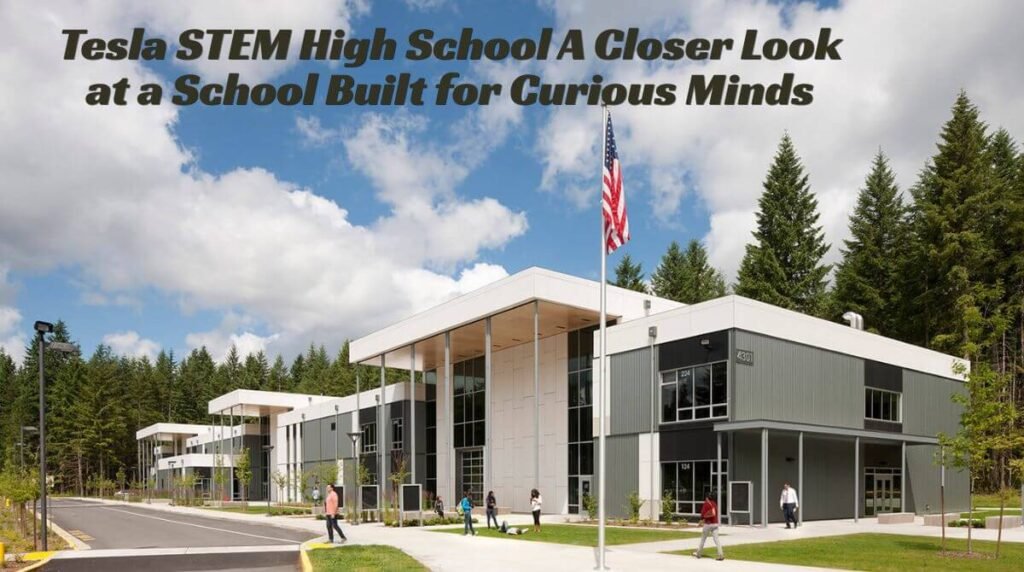
Tesla STEM High School is located in Redmond within Washington’s Lake Washington School District. The location puts the school close to one of the country’s best-known technology hubs. Redmond has strong connections to the technology industry and its surroundings naturally add to the school’s identity.
Still, the school is not simply a place where students learn about computers or technology. Its academic model covers a much wider range of subjects. Students encounter biology, chemistry, physics, mathematics, engineering concepts and other areas that support STEM learning.
Why Do Students Choose Tesla STEM?
So why would a student choose Tesla STEM over another high school?
One major reason is academic challenge. Students who enjoy difficult questions often want an environment where teachers expect them to go beyond memorizing facts. Tesla STEM aims to provide that challenge through advanced coursework and project-based learning.
The school also attracts students who already have a strong interest in STEM subjects. That creates an interesting school culture. Instead of being the only student in a class who gets excited about a complicated science problem, a student may find plenty of classmates who feel the same way.
Learning Through Real Problems
Traditional classroom learning often follows a familiar pattern. A teacher introduces a topic. Students study it. Then they take a test.
Tesla STEM takes a different approach in many areas. Students can work on projects that require research, collaboration and problem-solving. This matters because real-world problems rarely come with a neat set of instructions.
Imagine being asked to investigate a scientific question without knowing exactly what the answer should look like. You need to decide what information matters. You need to evaluate your sources. Then you need to explain what you discovered. That process can teach skills that reach far beyond a single exam.
Science Takes Center Stage
Science plays a particularly important role at Tesla STEM. Students study scientific ideas in depth and learn how researchers approach questions.
Rather than treating science as a collection of facts, the school encourages students to understand the process behind those facts. Why did scientists reach a particular conclusion? How could someone test the idea? What happens when the evidence does not support the original hypothesis?
Those questions can turn an ordinary lesson into an investigation.
Mathematics Has a Purpose
Mathematics can sometimes feel disconnected from everyday life. Students learn formulas and procedures without always seeing why they matter.
At a STEM-focused school, mathematics becomes a tool for solving problems. Students can use mathematical reasoning to understand scientific data, analyze patterns and support conclusions. As a result, math becomes less about simply getting the right answer and more about understanding how an answer works.
That shift can make a difference for students who enjoy logic and analytical thinking.
Technology Is Part of the Bigger Picture
The word “STEM” naturally makes people think about computers. Technology does matter at Tesla STEM, but it represents only one part of the school’s academic focus.
Students need to understand how technology connects with science, mathematics and engineering. A technological solution still needs careful research. An engineering project still depends on mathematical reasoning. A scientific discovery may eventually lead to a new technological application.
In that sense, the subjects support one another instead of standing alone.
Engineering Encourages Creative Thinking
Engineering requires more than knowing technical information. Students also need to think creatively.
When an engineering problem has several possible solutions, students must compare those options. They may need to build something, test it, discover a weakness and then make changes. Failure becomes part of the learning process rather than simply a bad grade.
That lesson can prove valuable later in college and in the workplace. After all, engineers rarely solve difficult problems perfectly on their first attempt.
What Is Student Life Like?
A challenging academic program raises another important question: what is life like outside the classroom?
Students at Tesla STEM still experience many familiar parts of high school. They participate in extracurricular activities, build friendships, take part in school events and prepare for life after graduation.
However, the academic expectations can shape the overall atmosphere. Students often need strong time-management skills because projects and advanced courses can require significant effort.
That means success depends on more than intelligence. Organization matters. Persistence matters. Knowing when to ask for help matters too.
The Importance of Collaboration
It might sound surprising that collaboration plays such an important role at a highly academic school. After all, people often picture STEM as an individual pursuit.
In reality, modern science and technology depend heavily on teamwork. Researchers collaborate. Engineers work in teams. Software developers communicate with designers and project managers. Medical researchers combine knowledge from different fields.
Tesla STEM’s collaborative approach helps students experience that reality while they are still in high school.
Is Tesla STEM Right for Every Student?
Probably not. And that is perfectly fine.
A school can be excellent without being the perfect fit for every student. Tesla STEM may appeal strongly to students who enjoy academic challenges and STEM subjects. Students who prefer a less intensive environment may feel more comfortable elsewhere.
Parents and students should therefore look beyond reputation. They should ask practical questions. Does the teaching style fit the student’s learning habits? Can the student handle a demanding workload? Does the student actually enjoy STEM subjects?
Those questions matter more than simply choosing a school because of its strong reputation.
Preparing Students for College
College preparation represents another important part of the Tesla STEM experience. Advanced coursework can help students develop habits that become useful in higher education.
Students learn to manage deadlines. They practice research. They write about technical subjects. They work through difficult problems. They also learn how to balance several responsibilities at once.
Those skills can make the transition to college easier. Of course, no high school can guarantee college success. Students still need to develop independence and continue learning on their own.
A Different Definition of Success
One of the most interesting aspects of a STEM-focused education is how students define success.
Getting a high grade certainly matters. However, solving a difficult problem can provide its own reward. Discovering why an experiment failed can teach something valuable. Finding a better way to approach a project can matter more than finishing quickly.
This mindset encourages students to see learning as a process.
The Bigger Picture
Tesla STEM High School represents a growing interest in education that connects classroom knowledge with real-world challenges. Technology continues to change the way people work and communicate. Scientific research continues to influence everyday life. Meanwhile, employers increasingly value people who can analyze problems and adapt to new situations.
Schools cannot predict exactly what students will face ten or twenty years from now. They can, however, help students develop the ability to learn, question and adapt.
That may be one of the strongest ideas behind the Tesla STEM approach.
Final Thoughts: Is It Worth Exploring?
Tesla STEM High School stands out because it creates an academic environment where curiosity and challenge sit at the center of the experience. Students encounter demanding subjects, collaborative projects and opportunities to connect classroom concepts with practical problems. The experience will not suit everyone, but for students who genuinely enjoy science, technology, engineering and mathematics, it can offer an exciting path through high school.
So, could Tesla STEM be the right fit for a student who loves asking “why?” and “what if?” Maybe. The best way to answer that question is to look closely at the school’s programs, expectations and culture before making a decision. And if you enjoy discovering more stories about schools, education and interesting topics, take a look at ViziToNews as well.